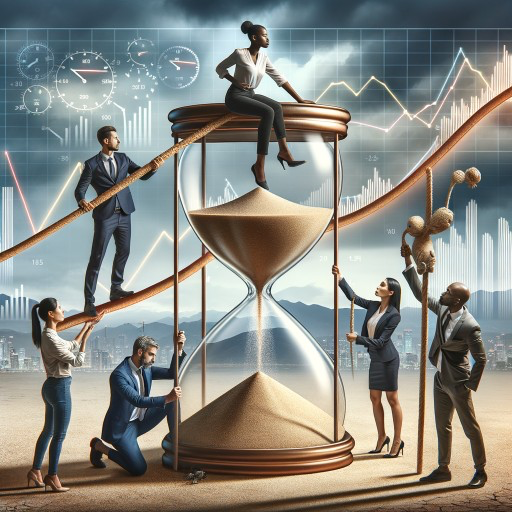
There is a phase in every serious business journey that few people prepare for. It is not failure, It is not collapse, It is not dramatic decline, It is the slowdown.
Revenue holds steady but stops climbing. Leads still come in but less aggressively. Engagement stabilizes instead of accelerating. Nothing is breaking — yet nothing feels like it is surging.
This is where many entrepreneurs make their biggest mistakes.
They panic. They pivot unnecessarily. They discount prematurely.They question their brand.
They abandon long-term positioning for short-term activity. But seasoned entrepreneurs understand something different:
A slowdown is often a structural transition — not a signal to abandon strategy, but a signal to refine it.
Sustainable businesses are not built on constant spikes. They are built on disciplined consolidation phases that strengthen infrastructure before the next expansion.
This guide explores — in depth — how smart entrepreneurs remain steady, analytical, and strategically grounded when visible progress slows.
Introduction
Entrepreneurship culture tends to glorify rapid growth.
Revenue screenshots.
Milestone celebrations.
Launch success stories.
“10X” headlines.
What is rarely discussed is the rhythm of business.
Growth is not linear. It moves in cycles:
- Expansion
- Stabilization
- Recalibration
- Re-expansion
The entrepreneurs who survive long term are not the ones who experience the fastest spikes — but the ones who remain disciplined during the quiet phases.
A slowdown tests:
- Emotional maturity
- Strategic clarity
- Operational depth
- Leadership stability
When momentum softens, uncertainty rises. And uncertainty tempts reaction.
Smart entrepreneurs resist reaction.
They lean into structure.
Let’s examine what that truly looks like beneath the surface.
1. They Zoom Out and Reassess the Strategic Architecture
When short-term metrics flatten, inexperienced founders zoom in obsessively.
Daily revenue.
Ad performance.
Click-through rates.
Open rates.
But tactical analysis without strategic context creates noise.
Smart entrepreneurs step back and ask deeper questions:
- Is our market evolving?
- Is our positioning still differentiated?
- Has our customer profile shifted?
- Are we solving a problem that remains urgent?
- Is this seasonal stabilization or strategic misalignment?
They conduct structured reviews of their entire business ecosystem — not just marketing performance.
Using systems like:
They document:
- Core mission clarity
- Offer hierarchy
- Pricing structure logic
- Customer journey mapping
- Long-term revenue targets
They revisit assumptions they made when growth was faster.
Sometimes, slowdown reveals that the initial growth phase was fueled by novelty rather than depth.
Sometimes it reveals saturation in a channel.
Sometimes it reveals messaging fatigue.
But strategic reassessment is calm. Analytical. Measured.
It is not driven by fear.
It is driven by alignment.
Smart entrepreneurs understand:
If the foundation is misaligned, acceleration will eventually collapse anyway.
Better to recalibrate deliberately.
2. They Replace Emotional Impulses with Data Intelligence
Slower growth often triggers emotional storytelling:
“People aren’t buying.”
“The market is saturated.”
“My brand is declining.”
But feelings are not facts.
Disciplined entrepreneurs look for patterns, not panic signals.
Using platforms such as:
They examine:
Traffic Behavior:
- Are visitors spending less time?
- Is bounce rate increasing?
- Has traffic source quality changed?
Conversion Mechanics:
- Has checkout friction increased?
- Are pricing objections rising?
- Is cart abandonment higher?
Customer Value:
- Has lifetime value declined?
- Has retention softened?
- Are repeat purchases decreasing?
Often, the slowdown is not in demand — but in conversion efficiency.
Or not in conversion — but in lead quality.
Or not in revenue — but in acquisition cost.
Data provides clarity. Clarity reduces fear. Reduced fear enables rational action.
Smart entrepreneurs refuse to make permanent decisions based on temporary emotional discomfort.
3. They Strengthen Operational Infrastructure
Growth phases often hide inefficiencies.
When revenue flows quickly, systems do not need to be perfect to function.
But when growth stabilizes, cracks become visible:
- Inconsistent onboarding
- Weak email nurturing
- Poor retention systems
- Fragmented internal processes
- Manual workflows consuming time
Rather than viewing slower seasons as stagnation, strategic founders treat them as infrastructure-building windows.
They optimize:
Email Systems
Through platforms like Mailchimp, they redesign sequences to improve long-term engagement and lifetime value.
Customer Support
Using systems like Zendesk, they strengthen trust through faster response times and structured resolution processes.
Automation & Workflow
They reduce manual dependency, freeing leadership energy for higher-level decisions.
Customer Journey Mapping
They refine each stage: awareness → consideration → conversion → retention → advocacy.
Infrastructure rarely creates viral spikes.
But it creates scalable consistency.
Without infrastructure, growth creates stress.
With infrastructure, growth creates leverage.
Smart entrepreneurs build leverage.
4. They Reinvest in Intellectual Capital
When external growth slows, internal growth becomes the priority.
Elite entrepreneurs treat slower cycles as educational seasons.
They deepen knowledge in:
- Behavioral economics
- Sales psychology
- Negotiation dynamics
- Market trend forecasting
- Financial modeling
Through structured platforms such as:
They acquire skills that expand decision-making capacity.
Because businesses do not outgrow their founder’s level of thinking.
They expand with it.
When the next expansion window appears — whether due to market shifts or improved positioning — they are not scrambling to learn under pressure.
They are prepared.
Preparation compresses future acceleration timelines.
5. They Protect Brand Equity Relentlessly
One of the most dangerous reactions during slow periods is brand dilution.
Discounting impulsively.
Changing messaging frequently.
Launching disconnected offers.
Chasing trends outside core positioning.
These actions may generate temporary revenue — but they weaken long-term authority.
Smart entrepreneurs ask:
“Does this strengthen or weaken our brand?”
Brand equity compounds slowly. But when strong, it creates:
- Pricing flexibility
- Higher trust
- Reduced acquisition cost
- Loyal customer ecosystems
A slowdown is not permission to abandon positioning.
It is an opportunity to reinforce it.
Consistency during quiet seasons builds credibility during loud ones.
6. They Manage Psychology as a Strategic Discipline
This may be the most overlooked element.
Entrepreneurial identity often becomes fused with performance.
When revenue rises, confidence rises.
When revenue stabilizes, doubt creeps in.
Smart entrepreneurs intentionally separate identity from metrics.
They maintain:
- Structured daily routines
- Financial forecasting clarity
- Personal reflection practices
- Physical discipline
- Controlled media consumption
They understand that emotional volatility leads to strategic volatility.
And strategic volatility confuses teams, customers, and partners.
Calm leadership creates organizational stability.
Organizational stability sustains revenue.
Psychological resilience is not motivational fluff — it is operational strategy.
7. They Recognize That Plateaus Often Precede Breakthroughs
Historically, many companies experience a flattening phase before scaling further.
Why?
Because systems are catching up.
Markets are adjusting.
Founders are evolving.
Offers are maturing.
The plateau becomes a pressure chamber.
Pressure refines clarity.
Clarity sharpens execution.
Execution triggers the next expansion cycle.
Entrepreneurs who survive plateaus gain something more valuable than temporary growth:
Durability.
Durability builds wealth.
Conclusion
Slow progress is not a verdict.
It is a diagnostic window.
It reveals:
- Structural weaknesses
- Strategic misalignment
- Psychological instability
- Operational inefficiencies
But it also provides space:
- To refine
- To recalibrate
- To strengthen
- To upgrade
The entrepreneurs who win are not the ones who avoid slow seasons.
They are the ones who use them wisely.
Stability today builds scalability tomorrow.
Call to Action
Another great blog, right?
But information alone does not build income.
Structure does.
Skill does.
Strategic execution does.
If you are serious about building a disciplined, sustainable, income-generating business — not one dependent on emotional momentum — then it’s time to go deeper.
You can explore all structured courses inside SMART(ER) Business Academy here:
👉https://smarterbizacademy.com/all-courses/
You can also review our exclusive membership offers designed for long-term entrepreneurs here:
👉https://smarterbizacademy.com/shop/
And if you want advanced frameworks, monetization models, and structured income-building strategies delivered directly to your inbox, join our email list.
Smart entrepreneurs don’t just read. They implement.